
Why Does a Reverse Phone Lookup Show the Wrong Name?

By Razib Mojumder
TL;DR
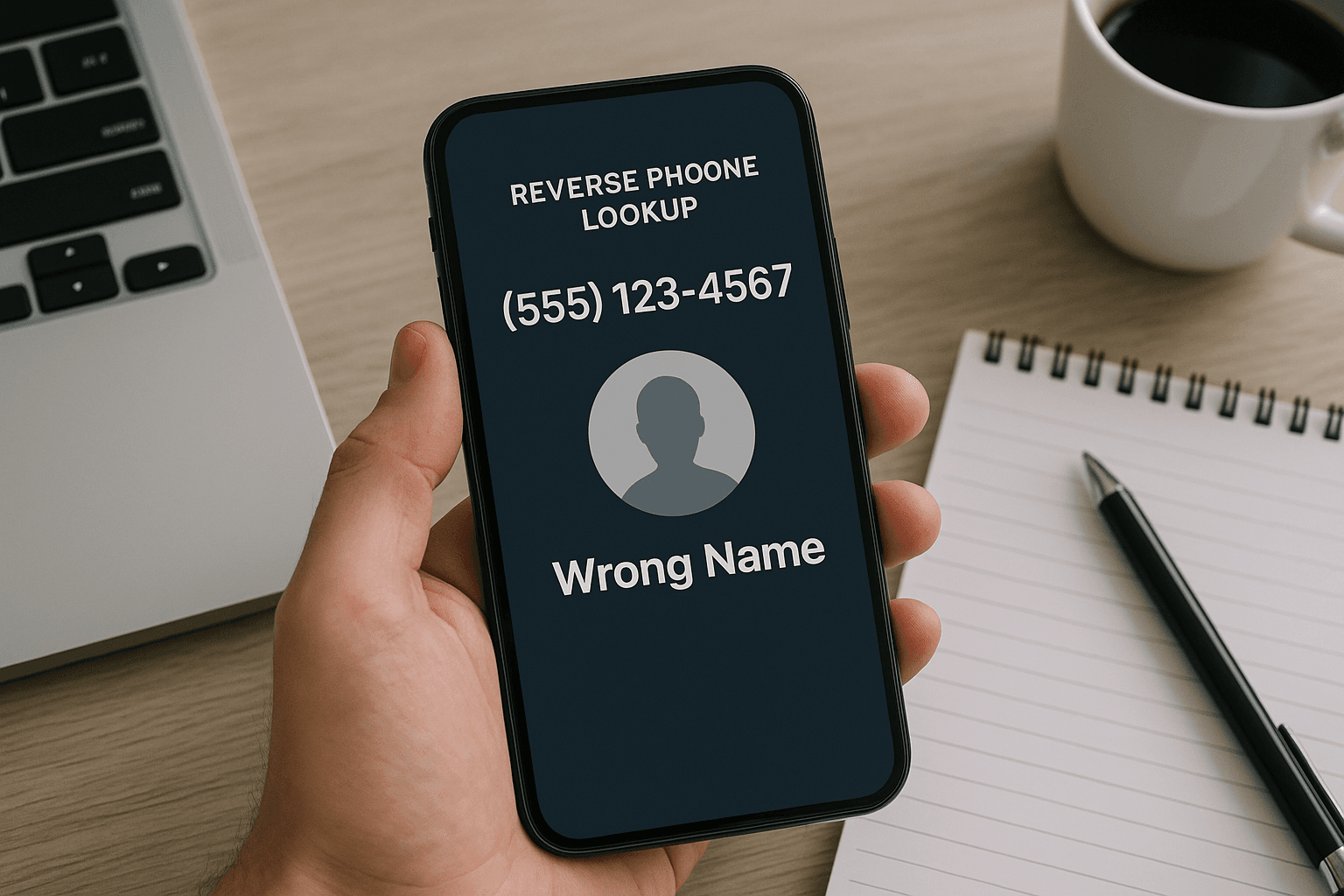
Reverse phone lookup services often show the wrong name because their databases contain outdated information, rely on incomplete public records, or pull data from when the number was previously owned by someone else. Phone numbers get reassigned to new users after disconnection, and many lookup services struggle to keep pace with carrier changes, prepaid accounts, and privacy-protected registrations. Third-party data aggregators also merge information from multiple sources, creating errors when details don’t align properly.
How Reverse Phone Lookup Services Work
Reverse phone lookup platforms compile information from numerous sources to match phone numbers with owner identities. These sources include public records, social media profiles, user-contributed data, commercial databases, and telecommunications carrier information. The process sounds straightforward, but the reality involves complex data aggregation across systems that don’t always communicate effectively with each other.
When you enter a phone number into a lookup service, the system searches its database for matching records. The service then displays whatever information it has associated with that number, which might include a name, address, carrier information, and sometimes even relatives or associates. The accuracy of this information depends entirely on how recently the database was updated and the reliability of the original sources.
Phone Number Reassignment Creates Confusion
One of the most common reasons for incorrect name associations is phone number recycling. When someone cancels their phone service, carriers don’t retire that number permanently. Instead, they place it in a quarantine period, and after a waiting period that can range from as little as 30 days to several months, they reassign it to a new customer. The Federal Communications Commission requires carriers to maintain these numbers in inventory rotation to prevent number exhaustion.
During this transition, lookup databases may still associate the number with the previous owner. If someone disconnected their service six months ago and you received their old number three months ago, many lookup services might still show the previous owner’s name. This lag occurs because these services don’t receive real-time updates from carriers about number reassignments, and they rely on slower-moving public records and user reports to update their information.
Database Update Delays and Information Lag
Even when information exists in public records or carrier databases, significant time passes before reverse lookup services incorporate these changes. Most services update their databases periodically rather than continuously, with some refreshing monthly, quarterly, or even less frequently depending on their business model and data access agreements.
Free lookup services typically operate with the oldest data because they lack the resources to purchase frequent database updates from commercial data brokers. Premium services generally maintain fresher information, but even they can’t achieve perfect real-time accuracy. The inherent delay between when you activate a new number and when that activation appears in consolidated databases means there’s always a window where lookups will show incorrect or missing information.
Prepaid and Privacy-Protected Numbers
Prepaid phone numbers present particular challenges for lookup accuracy. Unlike postpaid contracts that require identity verification and credit checks, prepaid services allow customers to activate numbers with minimal personal information. Many carriers don’t collect or verify full legal names for prepaid accounts, and the information they do collect rarely makes it into public-accessible databases.
Similarly, customers who opt for privacy protection services or register their numbers under business names rather than personal names create lookup discrepancies. Some people intentionally register phones using variations of their names, nicknames, or family member names for privacy reasons. When lookup services encounter these records, they display whatever name appears in the registration, which may not match the actual user’s legal name.
Data Aggregation Errors and Merge Conflicts
Reverse phone lookup companies don’t collect all their data directly from phone carriers. Instead, they aggregate information from dozens or hundreds of different sources, including social media platforms, online directories, public records, marketing databases, and user submissions. This multi-source approach creates opportunities for errors when information conflicts between sources.
When a lookup service finds your phone number associated with “John Smith” in one database but “J. Smith” in another and “Jonathan Smith” in a third, algorithms must decide which version to display. Sometimes these automated systems make incorrect choices, especially when dealing with common names, recently moved individuals, or households with multiple phone lines. Data merging errors compound when services incorrectly link phone numbers to addresses, and addresses to wrong individuals at those locations.
Business Lines and Shared Numbers
Business phone numbers frequently show up under business names in lookup services, which can seem incorrect if you’re expecting an individual’s name. Many small business owners use personal cell phones for business purposes, creating records where the same number appears associated with both a personal name and a business name depending on the source. Professional services providers, freelancers, and remote workers often blur these lines, making it difficult for lookup services to determine which name is “correct.”
Family shared plans create similar confusion. When multiple family members use phones under a single account holder’s name, lookup services typically show the account holder rather than the actual phone user. A teenager’s phone might show their parent’s name because that’s whose name appears on the carrier account and billing records.
Geographic Portability and Area Code Mismatches
Number portability regulations allow consumers to keep their phone numbers when switching carriers or moving to different geographic areas. Someone might have originally received a phone number with a New York area code but now live in California. Lookup databases that rely on area code geography to supplement their records might incorrectly associate this number with New York addresses or residents, showing completely wrong names based on outdated location assumptions.
This geographic disconnect becomes particularly problematic when lookup services cross-reference phone numbers with address databases. If the service assumes a 212 area code number belongs to someone in Manhattan and matches it with people at Manhattan addresses, it might display the wrong person entirely, especially if the actual number owner has ported that number to a different state.
Data Broker Practices and Information Trading
The reverse phone lookup industry operates largely on purchased and traded data from information brokers. These brokers compile dossiers on consumers from thousands of sources and sell access to companies providing lookup services. The Fair Credit Reporting Act regulates some of this activity, but many data brokers operate in less-regulated spaces where accuracy standards vary significantly.
Problems arise when brokers sell outdated information or when their data collection methods introduce errors. Some brokers use automated web scraping that can misattribute information, while others rely on inferred connections that may be incorrect. Once erroneous data enters the broker ecosystem, it can propagate across multiple lookup services that purchase from the same sources, making the same error appear widespread and difficult to correct.
User-Generated Content and Crowdsourced Data
Many reverse lookup platforms incorporate user-submitted information and reports into their databases. While crowdsourcing can help identify spam callers and update records, it also introduces accuracy problems. Users sometimes submit incorrect information, either through honest mistakes or intentional misreporting. Someone might report a number as belonging to “ABC Company” when it’s actually a personal number, or they might misidentify a caller based on assumptions.
These platforms often lack robust verification systems for user submissions, allowing unverified reports to appear alongside or even override more reliable data sources. If enough users report incorrect information about a number, that misinformation can become the primary result displayed by the service, creating a self-reinforcing cycle of error.
What You Can Do About Incorrect Listings
If a reverse lookup shows the wrong name for your number, you have several options for correction, though none offer instant results. Many lookup services provide opt-out or correction request forms on their websites. Submitting requests to major services like Whitepages, Spokeo, and BeenVerified can gradually reduce incorrect listings, though new ones may appear as other services scrape outdated data.
Contacting your phone carrier to ensure your account information is current and accurate represents another important step. While carriers don’t directly control third-party lookup services, accurate carrier records eventually propagate to some commercial databases. For privacy-conscious individuals, registering for the National Do Not Call Registry won’t fix lookup errors but can reduce unwanted calls that might prompt people to look up your number in the first place.
Understanding that perfect accuracy in reverse phone lookups is essentially impossible helps set realistic expectations. The decentralized nature of telecommunications data, combined with privacy protections, number portability, and the commercial nature of lookup services, means some level of error will always exist in these systems. The best approach involves assuming any lookup result might be incorrect or outdated and verifying information through direct contact when accuracy matters.
Frequently Asked Questions
How long does it take for reverse lookup databases to update after I get a new number?
Most reverse phone lookup databases take anywhere from several weeks to several months to reflect new number assignments. Free services typically update less frequently than paid services, sometimes taking six months or longer. The delay occurs because these services rely on periodic database purchases from data brokers rather than real-time carrier feeds, creating an inherent lag between when you activate service and when that information appears in lookup results.
Can I permanently remove my phone number from reverse lookup sites?
While you can request removal from individual lookup sites through their opt-out processes, permanent removal across all services is practically impossible. New lookup services constantly emerge, existing services re-scrape public data, and information can reappear even after removal. You’ll need to submit opt-out requests to each service individually and monitor for your information reappearing, which requires ongoing effort rather than a one-time fix.
Why do different lookup services show different names for the same number?
Different services use different data sources and update their databases on different schedules, leading to inconsistent results. One service might pull primarily from social media profiles while another relies more heavily on carrier records or public directories. When these sources contain conflicting information, each service displays whatever its particular data sources indicate, creating the appearance that all results are equally valid when some may be more current or accurate than others.
Will contacting my phone carrier fix incorrect reverse lookup results?
Contacting your carrier ensures your account information is accurate in their system, which is a good first step, but carriers don’t directly update third-party lookup services. Carrier information eventually flows to some commercial databases through data sharing agreements, but this process takes time. Your carrier can verify what name they have on file and correct it if wrong, but they can’t force lookup services to update their independent databases.
Are paid reverse lookup services more accurate than free ones?
Paid services generally maintain more current databases because they can afford more frequent updates from commercial data brokers, but they’re not guaranteed to be accurate. They typically provide more detailed information and fresher data than free alternatives, but all services face the same fundamental challenges with number reassignments, data lag, and source reliability. Paying for a service reduces but doesn’t eliminate the possibility of receiving incorrect information.
What should I do if someone keeps calling me about the previous owner of my number?
Politely explain that you’re the new owner of the number and have no connection to the previous person. For persistent debt collectors or business callers, send a written request asking them to update their records and cease contact. Document these interactions in case harassment continues. Unfortunately, you can’t force all outdated databases to update immediately, so some misdirected contacts may continue for months until various systems naturally refresh their information.
Can someone maliciously change what name appears in reverse lookup results?
While directly hacking lookup databases would be difficult, someone could potentially influence results by submitting false reports to services that accept user contributions or by creating fake social media profiles and online listings that automated scrapers might collect. However, most lookup services use multiple data sources, so completely replacing accurate information with false data across all services would be extremely challenging. Reputation management companies sometimes help clients suppress or modify their online presence, but this involves legitimate optimization rather than malicious manipulation.
Editorial Standards & Fact Checking
At NumLocate, our telecommunications and privacy guides are independently researched, cross-referenced with official FCC guidelines and carrier numbering plans, and reviewed to ensure consumer safety and accuracy.

Written by Razib Mojumder
Telecommunications & Digital Privacy Specialist
Razib is the lead researcher at NumLocate, specializing in caller ID authentication protocols, STIR/SHAKEN anti-spoofing frameworks, and practical digital privacy tools for everyday consumers.
Related Articles
 Phone Lookup
What Does Scam Likely Mean on Caller ID?
TL;DR “Scam Likely” on your caller ID is a warning label that your phone carrier automatically displays when an incoming call is suspected to be fraudulent or a scam. Major carriers like T-Mobile, AT&T, and Verizon use call analytics technology to identify suspicious calling patterns and flag these numbers before you answer. When you see […]
 Phone Lookup
Why Do Old Phone Numbers Have New Owners?
TL;DR Old phone numbers get reassigned to new owners because telecommunications carriers recycle disconnected numbers after a waiting period to manage the limited supply of available phone numbers. When someone cancels their service, switches carriers, or stops paying their bill, their number enters a holding period before returning to the available pool. This recycling process […]
 Phone Lookup
What Can an Area Code Tell You About a Phone Number?
TL;DR An area code reveals the geographic region where a phone number was originally assigned, whether it’s a landline or mobile number, and can help identify potential spam or scam calls. While area codes once definitively indicated a caller’s physical location, number portability and VoIP services have made this information less reliable. Area codes can […]